Sunday, September 14, 2014

Significant Erosion Event, Particularly at Beach One

I have been looking for the effects of sea level rise, and in particular related erosion along the coast, for some time now. What I have observed was this erosion is not as simple as many sea level rise models might suggest. In particular I had not noticed so much erosion at the pathways leading down to the beach. This suggested the ocean was not advancing a fast as many fear,  There was erosion, but it would be just one of the 5 “official” paths at a time that would show erosion at the base of the path. This along with other observations suggested to me that the erosion was mainly localised at any given time. This year has seen more significant events but they still seem somewhat localised.

Erosion Scarp at the bottom of teh Beach One RampAt the moment there is a very big “step” at the bottom of the beach one ramp (about 1.2m), where recent high tides have washed deep back into the dunes and also the revegetation fencing and drainage pit. Again there is ample evidence to suggest that the amount of erosion is more localised, rather than generally along the beach. Although this years king tides (around the time of full moons) and strong swells have lead to more erosion scarps along much of the coast than over the past couple of years.

The super moon term has caught the public’s imagination, but I strongly doubt it alone is responsible for a super tide. The moon was however a full moon and it occurred as the moon is closest to the earth, so there will be a contribution. The real culprits are combination of three additional things. Strong swells associated with a significant storm front last Tuesday (often this is referred to as a storm surge) The low air pressure associated with the storm which crossed the coast at Venus Bay just on sunset. Finally the presence of deep gutter (rip area) just south of beach one ramp (see photo below) which focused the wave action at a small semi-circular area in front of the ramp.

View out to sea from Beach One Ramp showing positiopn of gutter

Sunday, January 19, 2014

Wedgies and Wide beaches

  The recent King Tides have contributed to some fore-dune erosion at Beach One, exacerbated by the wide and mostly flat beach summer berm profile.

Meanwhile at Point Smythe a pair of Wedge-tailed Eagles Aquila audax were observed patrolling at a very low altitude for birds with such keen eye-sight. Their sustenance consists predominantly of carrion, but rabbits, some marsupials and other birds can feature in their diet.
These two birds are more than 5+ years old, as attested by their dark colour. Younger birds are browner, progressively turning towards black as they age. In this photo the larger sized female is below her male.

Friday, November 29, 2013

Shearwater Wreck

The Short-tailed Shearwater [Puffinus tenuirostris ] or mutton bird, has an amazing yearly migration, leaving our shore in autumn and flying to the waters off Siberia and Alaska before return to Australia in spring. Most of those coming along the beach at Venus Bay are returning to rockeries in Phillip Island, but there is also a big colony at Port Fairy. It is not uncommon for many of the birds to die of exhaustion during the migration, which leads to the phenomenon known as a shearwater wreck, where large numbers of dead birds are washed up on the beach.
clip_image001
A CALL FOR INFORMATION
The wreck of Short-tailed Shearwaters appears particularly abundant along the Australian coast this spring. The number of dead shearwaters lining the beaches seems to be higher and more widespread across the Australian coast, but unless we collect data and do this consistently, this is only an observation. With shearwaters representing the most globally abundant avian species, it becomes important to understand just how many die each season and what this means to overall numbers.
We would like to make a start toward greater understanding and to learn more about this year’s wreck in particular. It has been suggested that changes in food availability due to the warming of the oceans is taking its toll on these migratory seabirds.
As regular beach visitors, you can play a role in helping us learn more about this issue. Over time we can learn whether mortality rates vary from year to year and if these trends are consistent, and/or linked with any particular climatic events or food availability.
When you next take a walk on a beach (albeit to look for breeding resident shorebirds!), please record: date, time, beach name, location, distance walked (ideally the latitude and longitude of your starting and finishing point), number of dead and dying shearwaters.
Send this information in an email to: atlas@birdlife.org.au marked ‘shearwater wreck’ in the subject line.
…..  from a email request from Grainne Maguire, Birdlife Australia


Saturday, October 26, 2013

First Feathers

IMGP1864There where a lots of black feathers on the beach today, but no mutton bird carcasses. This possibly marks the return of the migrating shearwater (mutton birds). Let’s hope not as many perish this year.

Wednesday, February 20, 2013

Koala Observer Training & Venus Bay Pipi Report available

For those interested in learning how to spot, monitor and help Koalas, South Gippsland Landcare is hosting a seminar at Ruby Hall on February the 27th at 6:30pm. Link below;

http://www.fosk.org.au/

 
In other observing-related news, the latest report on the Stock Assessment of Venus Bay Pipis (2011) is released and available the DPI website, link below;

http://www.dpi.vic.gov.au/fisheries/about-fisheries/publications-and-resources/fisheries-reports/your-licence-fees-at-work-reports/2013/stock-assessment-of-venus-bay-pipis


Monday, December 24, 2012

Hooked on Bidgee-Widgee

Bidgee-Widgee (Acaena novae-zelandiae) is a native ground-cover of Australia and New Zealand which is endemic to the Point Smythe area.
It is through the burrs produced in Summer which attach to socks, pants or shoelaces that most people realise they have had an interaction with Bidgee-Widgee, unwittingly drafted as agents of seed dispersal. Each seed has four spines which terminate in minute barbs that hook onto clothing or animal hair, similar plants overseas inspired the invention of hook & loop fasteners like Velcro.

It does play an important role in soil binding and erosion control, and is tolerant of a wide range of conditions from shade to full sun, wet to dry soils, making it worthy of consideration for the local home garden. So the next time Bidgee-Widgee covers your socks in burrs, look on the bright side that your socks have become a free packet of seed!


Thursday, November 29, 2012

Hot Hot Hot!!!

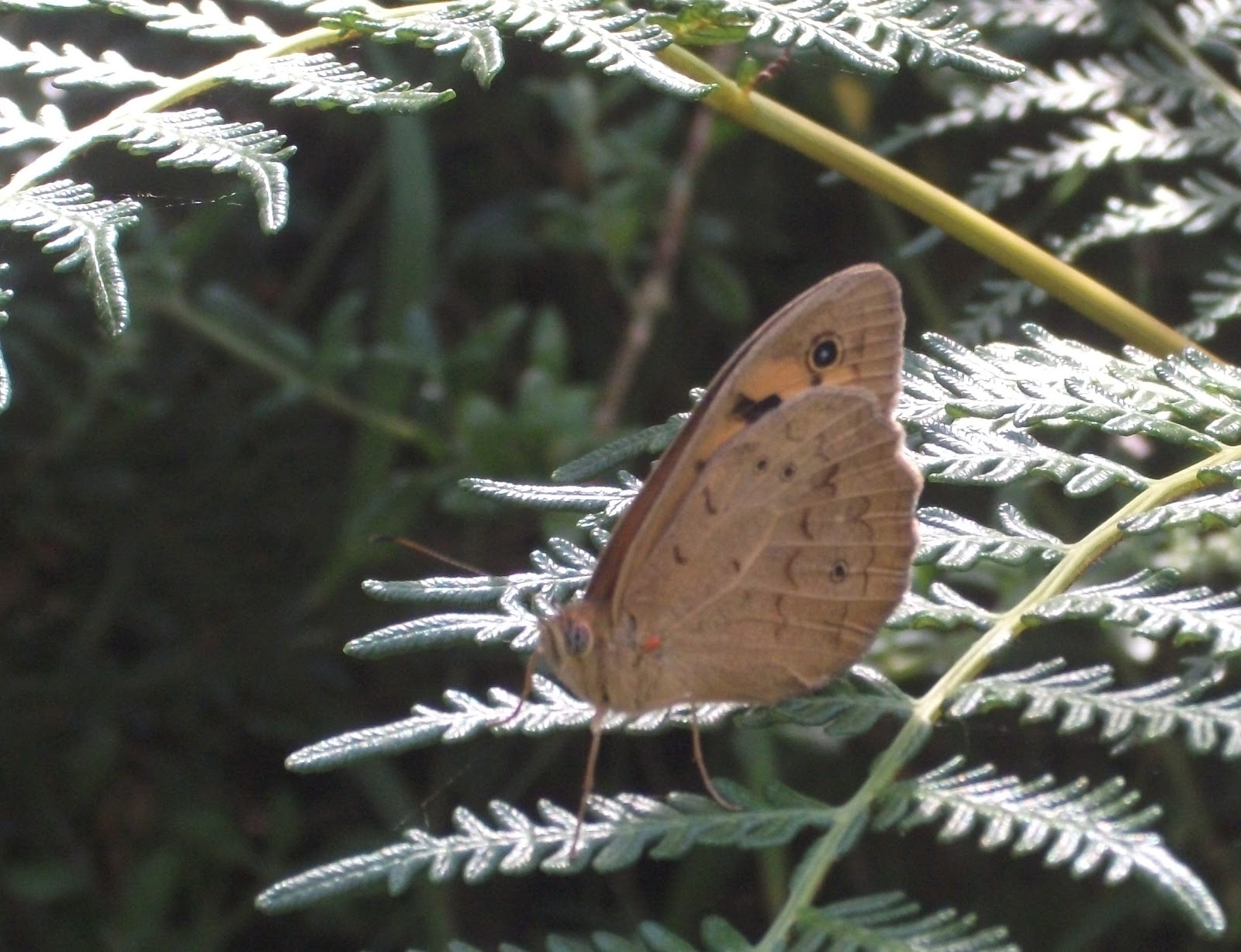
Common Brown Butterfly Heteronympha merope (male)
 
During the sweltering heatwave afflicting most of southern Australia this week, one could be excused for thinking that all animals suffer as we do in the heat. Ectothermic (cold blooded) animals however have a metabolism that works much more efficiently at temperatures that would risk heat-stroke for any bird or mammal species, including us. Often considered as "primitive lifeforms" it is only by observations during hot weather that this misconception can be challenged. 
 

Pale-flecked Garden Sunskink Lampropholis guichenoti

Unknown Bull Ant Myrmecia sp.


                                 Common Bottle-daisy Lagenophora stipitata

Saturday, September 22, 2012

Something To Sing About

All the signs that Spring has arrived in Venus Bay abound. The melodious calls of birds proclaiming territory and breeding rights fill the bush, and one of the most musical is the Golden Whistler Pachycephala pectoralis is hard for your ears to miss. (Male pictured above, females are duller and lack the black & white head markings).


The plants are also getting into the mood, with many beginning their flowering. The Running Postman Kennedia prostrata (above) delivers a crimson treat with its pea-like blooms. For keener eyes are the small Native Violets Viola hederacea (below) whose flower stalk stands only 10cms tall at most.

The Silky Guiana Flower Hibbertia sericea var. sericea (below).
What would Spring be without a Fungi responding to the rains and warmth? An Earth Star Geastrum sp. (right) adds yet another colour and texture to the community of life playing out the seasonal vocation of procreation.

Wednesday, August 8, 2012

Focusing on Andersen Inlet erosion risks

Once the peat layer is compromised the salt marsh quickly disintergratedsand is being washed further into the inlet and trees provide little resistance to erosion

I guess there has been a lot of discussion in this blog about changes on the surf beach at Venus Bay but in reality the most significant erosion is going on all along Andersen Inlet.The deeper channels (think of them as a submerged meandering but tidal streams) are snaking back and forth changing position within the inlet progressively widening the inlet and eroding its banks (particularly at Inverloch, on the north eastern side, and around doyle’s road, on the western side. Sand is progressively  moving deeper into the inlet and this hinders the development of mangroves, which are really the only way to slow down eroding the shores. The open “beaches” allow waves to undercut the peat layer of the salt marshes and once compromised like this the salt marshes quickly wash away. Trees offer only slightly more resistance but they soon also succumb to the erosion.

Tuesday, June 19, 2012

Did the earth move for you?

alvin earthLast nights earthquake between Moe & Mirboo North, best estimates at the moment a 5.4 Magnitude at 8:54PM, gave the folk in Melbourne a good shaking, but how was it felt at Venus Bay?
Geoscience Australia likes to get reliable first hand accounts of what people felt, as it helps them improve both the assessment and prediction of the effects of earthquakes & damage. If you want to help here is the link,

Saturday, June 16, 2012

Having fun …BUT

 IMGP4776 IMGP4777 IMGP4778
These very noisy mechanized wave runners are obviously have fun, albeit in a high risk way BUT they certainly didn’t impress the other beach one users. The fishermen were muttering about yoboos, the pipi gathers were yabbering about the strong smell of the spilt fuel and the tradition board riders shaking their heads in despair, What I notice is their wasn’t a single bird to be seen anywhere close by. Yet up at beach five there were plenty.
IMGP4818 
Is this a case of NIMBY over-reaction or is jet skying one of those recreations that really does needs to be controlled in national parks?

Thursday, June 14, 2012

Kings Tides and beach profile

IMGP4545 VBOP

At the same time as last weeks, transit of venus there was also a full moon and a very low atmospheric depression out to the east over the Tasman Sea.. Perfect conditions for a really high tide. I did check the beach on the 7th. and could only see the old erosion face from last year and the regrowth on the sand screen below them. There was a slight notch in several location that looked as if it could be more than a few days old but it was not very extensive (these are labeled in white in the above photo). I revisited the same areas south of beach one today and can see a fresh cut (only 5 to 20cm tall) but extending most of the way along the beach (labeled in yellow). Also the beach below the cut does seem to be “steeper”. So I suspect there has been some significant erosion/sand movement along the beach in the past week. So the picture that the erosion events are most likely to occur with the king tides (full moon) and atmospheric lows does have a little more circumstantial support.

Saturday, June 9, 2012

Venus Bay Inspired Art

The Last Pipi Harvest at Venus Bay

IMG_4277
Mixed Media on Canvas
102 by 102cm
By Norm Hanson 2012
imageThis is a story of anthropogenic extinction, as written into future stone. The ochre coloured sandstone [1] was at one time a thriving beach, brimming with life and specifically a prolific population of Donax Deltiodes, also known as Pipis or Surf clams. However the Pipis were so yummy and they were harvested in such numbers that fewer and fewer shells reached maturity each year. Then suddenly in one season, the entire population failed to reproduce. Worse the rich food chain of the beautiful beach collapsed, with their demise, and the once thriving beach became a pale version of itself. Only a few brave worm burrows [2] could be found. Then all signs of life disappeared [3].

This story need not come true.

IMGP3915
The work was created first as a mould of the main units in the sand south of Beach one. This included leaving some of the worm burrow/air holes undisturbed. broken Pipis and other shells where collected nearby and scattered in the mould. The mould was filled with expanding polyurethane foam and cover with the canvas, burried and left to harden for an hour or so. The foam on canvas mould was next painted with several coats of sand, gesso and latex to create an absorbent sandstone like finish. Finally this was “stained” and painted with various oxides. It represents a future geological rock face, perhaps a few million years into our future. This rock face runs close to the bedding planes with the oldest layers, the ochre sandstone on the lower left, closest to you. You are looking "up" in time.

This work will be on display at the Mount View Art Show, 14th - 17th June 2012

Saturday, June 2, 2012

The Transit of Venus

Second contact of Ingress taken in 2004Providing the skies are cloud free, Venus Bay will be a great place to observe the Transit of Venus. Remember you must not look directly at the sun SERIOUS EYE DAMAGE MAY RESULT.
The transits of Venus, they are like an eclipses, are very rare but when they occur there are two such events 8 years apart. During the transit Venus is positioned between us and the sun and casts a shadow. Unlike an eclipse of the moon this show is small and seen as a small dark dot as it moves across the face of the sun.
This is only the fifth transit since James Cook travelled to Tahitti in 1769 to make observation there. Astronomers back in England wanted to know exactly how long the transit took and from that they predicted they would be able to compute the distance of the earth and Venus from the sun. This trip is also famous because on the way back to England he reach Australia, called it New South Wales and claimed it for England.

When?

There are four key events in the transit
First touches the sun
8:18 AM
Just inside the Sun, ingress
8:34 AM
Just inside the Sun, egress
2:27 PM
Last Touches the Sun
2:45 PM


Where is the best place to observe?

Well really anywhere around Venus Bay you can see the sun at the times above. Remember the sun will be relatively low in the sky during the Ingress. So I might start my own observations just near lees Road and Jupiter avenue intersection, on the bike track as it comes off the little rise. There is a very clear view of the eastern sky from here. During the Egress the car park at Beach One is a good location as it has a good view of the north western sky.


The Venus Bay, Tarwin Lower Men’s Shed are having activities around observing the transit, weather permitting, including a sausage sizzle & live music from local artists. They will have a solar telescope for safe viewing of the transit, solar flares, sunspots and active regions of the sun. Gold Coin Donation. Check the May edition of Matter of Fact Newsletter for more details.

How to Observe?

I will be using the same method used by captain cook. I will project an image of the sun onto a screen using my telescope. I took the picture below of the transit in 2004 and I’m hoping I can do better this time.
Taken in Wheelers Hill on 8 June 2004
The Sydney observatory has a great factsheet on the 6 June 2012 Transit of Venus. If you’d like more information of making observations yourself, it will even help you do the calculations of distance to the sun and Venus if you want to independently verify the astronomers work.

Wednesday, May 16, 2012

Sand in movement

Panoramic photo taken on Tuesday at Beach 1 showing some erosion occurring to the fore-dune. Notice the water pooling in the bottom right.


This next photo is facing SE at the same site and the undulating effect from the pooling water extends to the horizon.  Truly a dynamic environment!

Sunday, April 8, 2012

Bad weather for Sailors, but good for Diatoms

Beach One was the location of a mass stranding of Velella lata, more commonly known as by-the-wind-sailors. These little blue creatures are no more than 5cm long and are related to jellyfishes and anemones. Their natural habitat is on the surface of the open ocean, where the Velella feed on plankton.


They move across the ocean with their distinctive transparent "sail" catching the wind, visible in this first picture.

Every now and again a change of wind direction (like the cold blast we are currently experiencing) blows thousands of Velella helplessly towards the shore.
This second picture shows the underside of the Velella where its feeding tentacles are visible.


The same sort of weather that was responsible for the stranding of the Velella brought waters rich in nutrients that has allowed the Diatoms to bloom along the surf of Beach One.


This picture taken this morning at Beach One showing the characteristic browny-green "stain" of a Diatom bloom.


Saturday, February 4, 2012

WEEDS WEEDS EVERYWHERE!


There is no set definition of what a weed is, other than that they are always undesirable. In the context here I am referring to plants that are not endemic to an area, and that escape into our natural areas to become weeds.


This is undesirable for two main reasons;


  • It changes our natural areas from being natural, which is the reason those areas are valued in the first place.


  • It alters the balance in the ecosystem. The weeds out compete the native seedlings, so natural regeneration gets hampered. The native animals are all linked to the native vegetation and start to struggle, and pest animal species often displace them.


What can we all do?


Learn to recognise a few of the weeds, and which ones are particularly nasty. Below are a couple of useful links,


South Gippsland Weeds;


http://www.southgippslandweeds.com.au/


and the DPI's weed site;


http://www.dpi.vic.gov.au/agriculture/pests-diseases-and-weeds/weeds


The weeds pictured are from top to bottom; Ragwort Senecio jacobaea, Inkweed Phytolacca octandra & Spear Thistle Cirsium vulgare.

Wednesday, January 25, 2012

Celebrating Australia Day

IMG_0765

What better place to celebrate Australia Day than on Beach One. Good job all you nippers and dedicated surf club patrols.